Auri
Technology that steps in before stress spirals — designed and prototyped with AI tools that cut production time by 40%.
B2C • Mobile App
Role
Role
End-to-End UX/UI Design
End-to-End UX/UI Design
Duration
Duration
June 2025 (3 weeks)
June 2025 (3 weeks)
Tools
Tools
Figma, Claude, ChatGPT,
Lyssna, Stitch AI, Otter AI
Figma, Claude, ChatGPT,
Lyssna, Stitch AI, Otter AI

At a glance
THE CHALLENGE
People only recognize stress after it overwhelms them, trapped in reactive damage control instead of prevention.
THE OPPORTUNITY
Wearable devices already track biometrics in real time, an untapped signal for catching stress before it takes hold.
THE SOLUTION
Auri uses AI-powered biometric pattern recognition to catch stress before it spirals and sends a gentle nudge to bring it into awareness. Users can release the tension right away with a guided exercise, or come back to it later, once the moment has passed. Either way, the goal is the same: giving the body a way out of the storm before it's too caught up to notice.
CONSTRAINTS
A 3-week sprint meant leaning on AI tools to move fast, while staying grounded in validated psychological research (Perscieved Stress Scale in Clinical Psychology), translated into language that felt warm and human, never clinical or data-heavy.
💡 solution preview
Anticipate, Nudge, Support.
When stress thresholds emerge, users are prompted with personalized coping options: grounding exercises, brief breathwork, or movement — designed to integrate naturally into their routine and grow more accurate over time.
Anticipate, Nudge, Support.
When stress thresholds emerge, users are prompted with personalized coping options: grounding exercises, brief breathwork, or movement — designed to integrate naturally into their routine and grow more accurate over time.

💡 solution preview
Research Approaches
Closing the gap between noticing stress and knowing what to do about it by interviewing 1:1, seeing trends in the market, and what other apps are doing with biometrics.
Closing the gap between noticing stress and knowing what to do about it by interviewing 1:1, seeing trends in the market, and what other apps are doing with biometrics.
01. USER INTERVIEWS
I interviewed 6 people managing chronic stress to understand why awareness rarely turns into action.
The common trend from each conversation was this: users lacked awareness of stress onset, wanted prediction over tracking, and had no appetite for more manual work layered onto an already stressful day.
I interviewed 6 people managing chronic stress to understand why awareness rarely turns into action.
The common trend from each conversation was this: users lacked awareness of stress onset, wanted prediction over tracking, and had no appetite for more manual work layered onto an already stressful day.
I only realize it after I'm overwhelmed. I don't stop myself and think, oh, I have to meditate."
I only realize it after I'm overwhelmed. I don't stop myself and think, oh, I have to meditate."
I only realize it after I'm overwhelmed. I don't stop myself and think, oh, I have to meditate."
— Quote from interview participant
— Quote from interview participant
02. TREND MATRIX
With the awareness gap confirmed, I mapped a trend matrix to see whether the market was actually ready for a preventive approach.
The analysis pointed to a pivotal shift: wellness is moving from reactive damage control toward predictive intervention, users want prevention, and the technology to deliver it already exists. No one had built the bridge yet.
With the awareness gap confirmed, I mapped a trend matrix to see whether the market was actually ready for a preventive approach.
The analysis pointed to a pivotal shift: wellness is moving from reactive damage control toward predictive intervention, users want prevention, and the technology to deliver it already exists. No one had built the bridge yet.

03. COMPETITIVE ANALYSIS
Oura Ring and Natural Cycles proved users trust devices to anticipate their needs when predictions are accurate. If biometrics could predict readiness or fertility, the same logic could apply to stress, a gap nobody had closed yet.
Oura Ring and Natural Cycles proved users trust devices to anticipate their needs when predictions are accurate. If biometrics could predict readiness or fertility, the same logic could apply to stress, a gap nobody had closed yet.
Oura Ring and Natural Cycles proved users trust devices to anticipate their needs when predictions are accurate. If biometrics could predict readiness or fertility, the same logic could apply to stress, a gap nobody had closed yet.

Oura Ring
Predicts readiness based on sleep scores & daily biometrics

Natural Cycles
Predicts fertility windows to increase the chances of conception
Ideation
Ideation
01. USER ARCHETYPES
Designing for the person who needs relief now, and the one who has time to explore.
Designing for the person who needs relief now, and the one who has time to explore.
I built two user archetypes to lead my design decisions. Maya and Jordan from interview patterns: two people trapped in reactive stress cycles, but with different urgency levels. Every decision had to hold up for both: effortless, trustworthy, proactive.
I built two user archetypes to lead my design decisions. Maya and Jordan from interview patterns: two people trapped in reactive stress cycles, but with different urgency levels. Every decision had to hold up for both: effortless, trustworthy, proactive.
I built two user archetypes to lead my design decisions. Maya and Jordan from interview patterns: two people trapped in reactive stress cycles, but with different urgency levels. Every decision had to hold up for both: effortless, trustworthy, proactive.

Jordan
Wants to explore data & relevant coping tools

Maya
Wants immediate relief before stress snowballs
02. DESIGN DECISIONS
— Choosing contextual support over another library to browse.
— Choosing contextual support over another library to browse.
Users wanted help in the moment, not more content to sort through. That led to three calls: a dashboard-first layout for immediate action, an AI chatbot over a wellness library, and two focused screens instead of three scattered ones.
Users wanted help in the moment, not more content to sort through. That led to three calls: a dashboard-first layout for immediate action, an AI chatbot over a wellness library, and two focused screens instead of three scattered ones.
Users wanted help in the moment, not more content to sort through. That led to three calls: a dashboard-first layout for immediate action, an AI chatbot over a wellness library, and two focused screens instead of three scattered ones.

Creating a feature matrix to analyze the imapct it will have for our users.

Same product, two paces: Maya moves straight to relief, Jordan explores before acting.
— Two people, two speeds, one path to relief.
— Two people, two speeds, one path to relief.
I mapped how Maya and Jordan each move from stress prediction to intervention to biometric validation, testing whether the same system could flex for both an immediate response and a more curious, exploratory one.
I mapped how Maya and Jordan each move from stress prediction to intervention to biometric validation, testing whether the same system could flex for both an immediate response and a more curious, exploratory one.
I mapped how Maya and Jordan each move from stress prediction to intervention to biometric validation, testing whether the same system could flex for both an immediate response and a more curious, exploratory one.

Maya, mid-meeting, gets an AI-predicted stress spike alert and completes a guided breathing exercise in the gap between calls. If she ignores the notification, Auri keeps reading her biometrics quietly in the background rather than pushing again.
Maya, mid-meeting, gets an AI-predicted stress spike alert and completes a guided breathing exercise in the gap between calls. If she ignores the notification, Auri keeps reading her biometrics quietly in the background rather than pushing again.

Jordan checks in on his own time, taps into the AI chatbot to understand what his patterns mean, and walks away with a personalized coping tool he can act on immediately, or discover more options through the wellness library if the first one doesn't fit.
Jordan checks in on his own time, taps into the AI chatbot to understand what his patterns mean, and walks away with a personalized coping tool he can act on immediately, or discover more options through the wellness library if the first one doesn't fit.
Utilizing Emerging AI tools
Utilizing Emerging AI tools
Using AI to stick with the 3-week sprint, without losing the product's integrity. The impact was that it compressed weeks of research synthesis into days while ensuring clinically validated framework for perceieved stress.
Stitch AI — accelerating concept wireframes.
Stitch AI — accelerating concept wireframes.
I used Stitch AI to generate mid-fidelity concept screens from a written prompt based describing my low-fidelity concept, cutting wireframing time by 50% and freeing up more cycles for user feedback.
Impact: helped me decide to pause the wellness library early, based on real feedback instead of assumption.
I used Stitch AI to generate mid-fidelity concept screens from a written prompt based describing my low-fidelity concept, cutting wireframing time by 50% and freeing up more cycles for user feedback.
Impact: helped me decide to pause the wellness library early, based on real feedback instead of assumption.
I used Stitch AI to generate mid-fidelity concept screens from a written prompt based describing my low-fidelity concept, cutting wireframing time by 50% and freeing up more cycles for user feedback.
Impact: helped me decide to pause the wellness library early, based on real feedback instead of assumption.

Low-Fidelity Concepts turned into quick mid-fi's for concept testing in user interviews
Low-Fidelity Concepts turned into quick mid-fi's for concept testing in user interviews
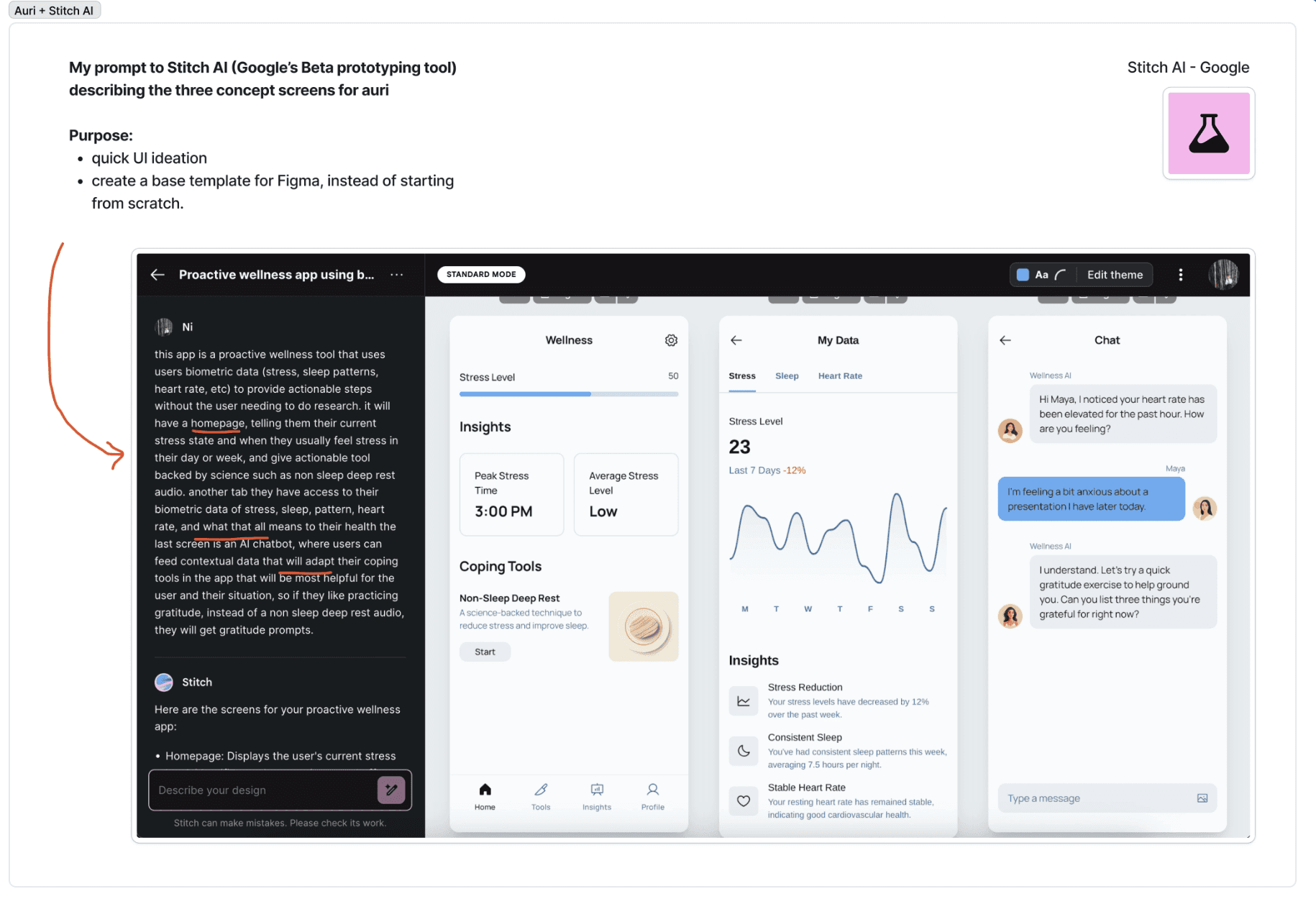
Prompt process from low-fidelity to mid-fidelity
Prompt process from low-fidelity to mid-fidelity
ChatGPT — grounding the stress score in real research.
ChatGPT — grounding the stress score in real research.
Instead of inventing a scoring system, I adapted the Perceived Stress Scale (PSS-10) into biometric indicators through prompt engineering, then refined it through iteration: an early 0–100 score felt clinical ("65, Tense & Drained"), so the final version moved to a simple 1–5 scale with human language ("Moderately Elevated").
Impact: removed the guesswork from building a resilience score users could trust.
Instead of inventing a scoring system, I adapted the Perceived Stress Scale (PSS-10) into biometric indicators through prompt engineering, then refined it through iteration: an early 0–100 score felt clinical ("65, Tense & Drained"), so the final version moved to a simple 1–5 scale with human language ("Moderately Elevated").
Impact: removed the guesswork from building a resilience score users could trust.
Instead of inventing a scoring system, I adapted the Perceived Stress Scale (PSS-10) into biometric indicators through prompt engineering, then refined it through iteration: an early 0–100 score felt clinical ("65, Tense & Drained"), so the final version moved to a simple 1–5 scale with human language ("Moderately Elevated").
Impact: removed the guesswork from building a resilience score users could trust.
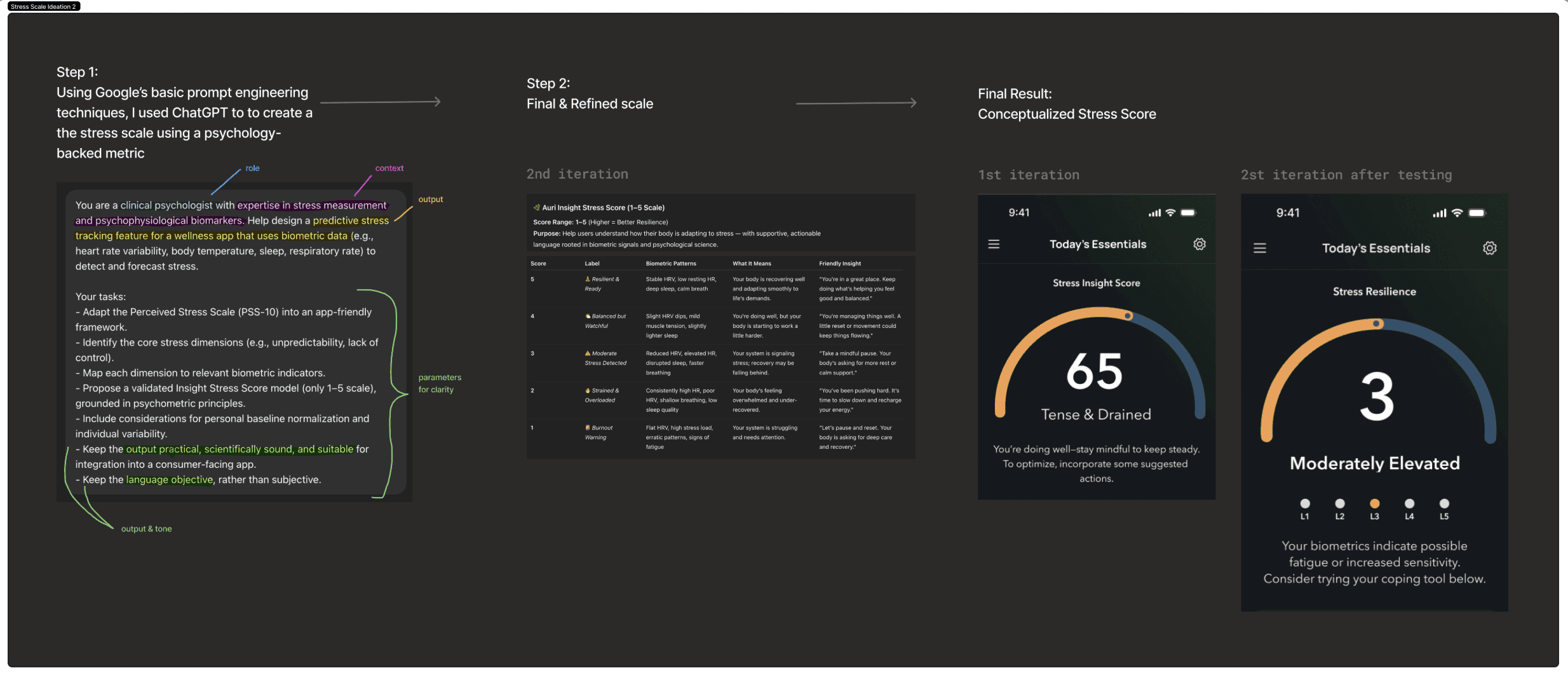
My step-by-step process from prompting, reviewing the framework & UX writing, and designing the stress scale.
My step-by-step process from prompting, reviewing the framework & UX writing, and designing the stress scale.

Refining the step 2, which was the language centered around the stress scale
Refining the step 2, which was the language centered around the stress scale
Branding
Positioning stress support as elevated, not clinical.
Positioning stress support as elevated, not clinical.
From a brand positioning standpoint, I made the design decision to use dark mode to signal "premium wellness within reach," similar to Oura Ring's approach, reducing overstimulation in a category full of bright, clinical interfaces. This design decision was created from au
Keywords: modern, organic, intelligent, elevated.
I started with qualitative research, since hormonal wellness isn't one-size-fits-all: how a nurse manages her cycle looks nothing like how a college student does.
Six user interviews, spanning students, nurses, and full-time moms, surfaced the behavioral patterns behind why tracking wasn't sticking.
I started with qualitative research, since hormonal wellness isn't one-size-fits-all: how a nurse manages her cycle looks nothing like how a college student does.
Six user interviews, spanning students, nurses, and full-time moms, surfaced the behavioral patterns behind why tracking wasn't sticking.

High Fidelity Design
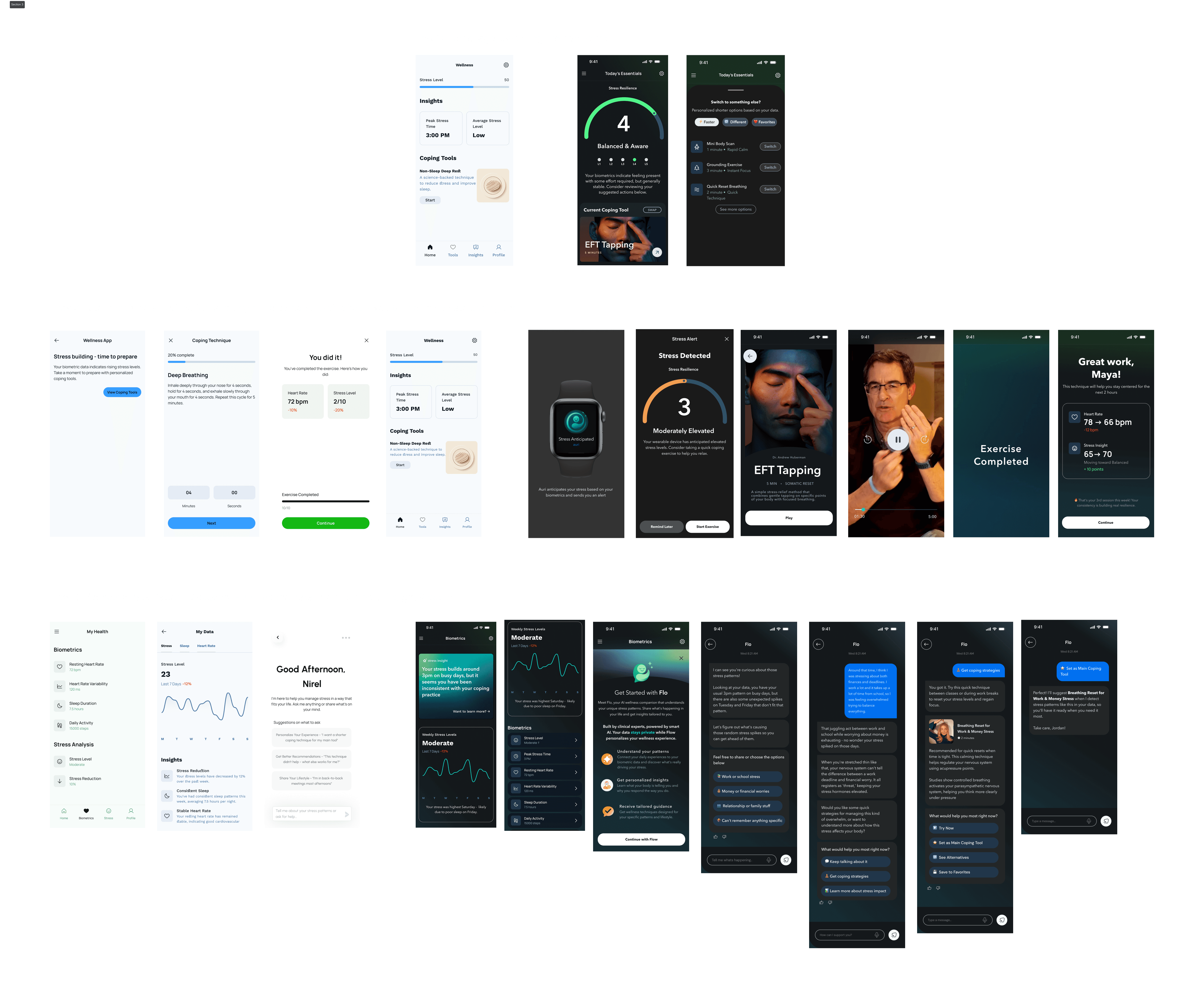
After determining the core flows for the designs I wanted to test, I sketched out the initial designs referencing existing app layouts to keep the design familiar and intuitive.
After determining the core flows for the designs I wanted to test, I sketched out the initial designs referencing existing app layouts to keep the design familiar and intuitive.
Usability Testing
Positive reactions, with room to make it feel less clinical.
Positive reactions, with room to make it feel less clinical.
Six participants matching target criteria (anxiety patterns, mixed wearable usage) completed three core tasks: responding to a stress alert, switching coping tools mid-task, and interpreting biometric insights.
I started with qualitative research, since hormonal wellness isn't one-size-fits-all: how a nurse manages her cycle looks nothing like how a college student does.
Six user interviews, spanning students, nurses, and full-time moms, surfaced the behavioral patterns behind why tracking wasn't sticking.
I started with qualitative research, since hormonal wellness isn't one-size-fits-all: how a nurse manages her cycle looks nothing like how a college student does.
Six user interviews, spanning students, nurses, and full-time moms, surfaced the behavioral patterns behind why tracking wasn't sticking.
Ease of use:
4.7/5
Users acted on recommendations without hesitation, the app felt natural and required minimal cognitive effort during stress moments.
Empowered:
100%
Participants felt more in command of their stress patterns, rather than reactive to them.
“It took the burden away from me. It made the app feel effortless, not like another task.”
💬 Adam, Participant
Real Quote from the Usability testing
Intuitiveness:
95%
They were able to interpret what one had to do in each page without explaination
Intuitiveness:
95%
They were able to interpret what one had to do in each page without explaination
Usability:
100%
All were able to perform each task in a moderated setting
Usability:
100%
All were able to perform each task in a moderated setting
“I feel like I’m actually taking care of myself when I use this app
“I feel like I’m actually taking care of myself when I use this app
💬 Ashley, Participant
Real Quote from the Usability testing
Iterations
Feedback centered on clarity, not concept. Three changes followed:
Feedback centered on clarity, not concept. Three changes followed:
01. a simpler, less clinical stress score (0–100 → 1–5, with plain language)
02. language that stopped assuming how users felt
03. more user control, including a visible swap option and a feedback loop (thumbs up/down) to personalize suggestions over time.
01. a simpler, less clinical stress score (0–100 → 1–5, with plain language)
02. language that stopped assuming how users felt
03. more user control, including a visible swap option and a feedback loop (thumbs up/down) to personalize suggestions over time.
01. a simpler, less clinical stress score (0–100 → 1–5, with plain language)
02. language that stopped assuming how users felt
03. more user control, including a visible swap option and a feedback loop (thumbs up/down) to personalize suggestions over time.

Final Prototype
Final Prototype
Final Prototype
Catch Stress Early & Take Action.
Catch Stress Early & Take Action.
Detects early signs of stress and nudges users to take proactive action with a personalized coping tool.
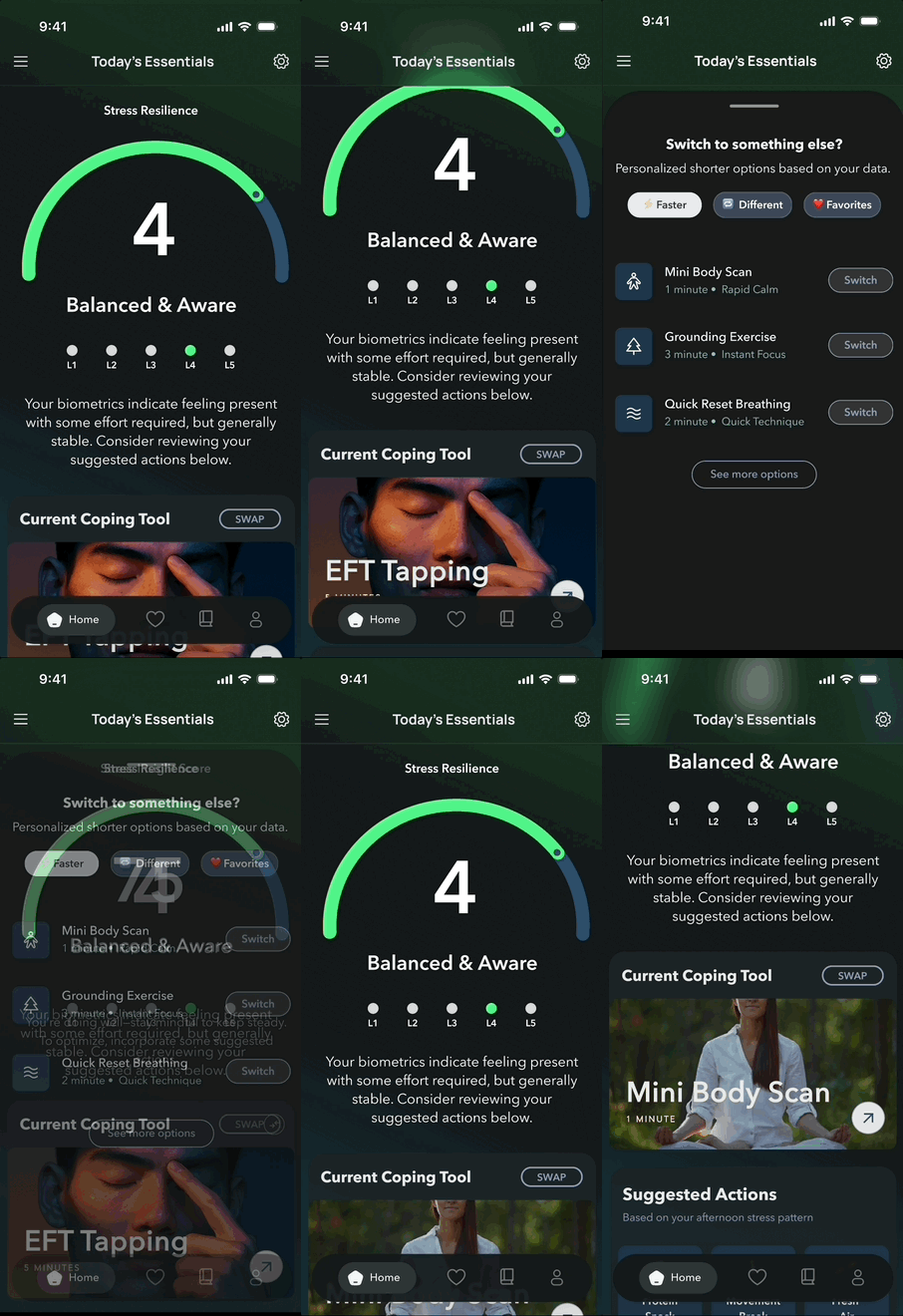
Swap Your Coping Tool
Swap Your Coping Tool
Easily switch to a different coping method based on current needs, directly from the home screen.
AI Chatbot for Support & Insights
AI Chatbot for Support & Insights
Users can ask the chatbot for context around their stress, get tailored suggestions, or swap tools—all in one conversation.

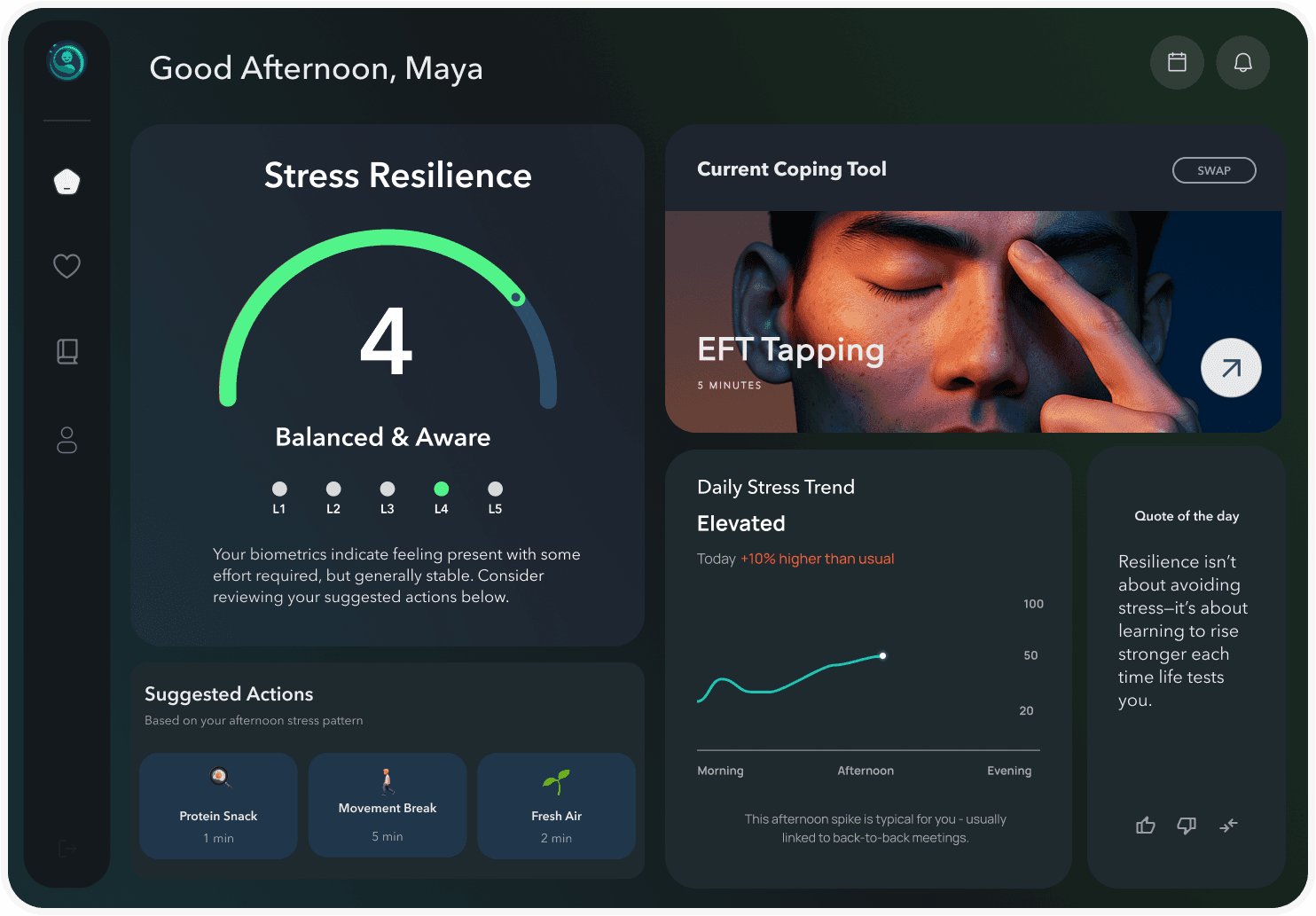
Responsive dashboard application
Access your stress insights and tools seamlessly across mobile, tablet, and desktop.
Reflections
What I learned about incorporating AI in the process
What I learned about incorporating AI in the process
AI was able to streamline my design production, not judgment. Every output still needed a design decision behind it, including what to keep, what to simplify, and what felt too clinical to ship. The AI couldn't catch aspects of user feedback either, such as the stress scale UX copy feeling too "robotic". AI a a tool is only as good as the judgement directing it, which continues to inspire me to be a curious designer focused on innovation because production can now be sped up.
I started with qualitative research, since hormonal wellness isn't one-size-fits-all: how a nurse manages her cycle looks nothing like how a college student does.
Six user interviews, spanning students, nurses, and full-time moms, surfaced the behavioral patterns behind why tracking wasn't sticking.
I started with qualitative research, since hormonal wellness isn't one-size-fits-all: how a nurse manages her cycle looks nothing like how a college student does.
Six user interviews, spanning students, nurses, and full-time moms, surfaced the behavioral patterns behind why tracking wasn't sticking.
If I did this again, I'd question the scope of adding the responsive dashboard.
If I did this again, I'd question the scope of adding the responsive dashboard.
Without user research to back it, I assumed bigger screens meant better access and built a responsive dashboard around the application. In a 3-week sprint, that was time spent on an unvalidated bet rather than the core phone experience. I’d test the assumption first, or cut the scope entirely.
I started with qualitative research, since hormonal wellness isn't one-size-fits-all: how a nurse manages her cycle looks nothing like how a college student does.
Six user interviews, spanning students, nurses, and full-time moms, surfaced the behavioral patterns behind why tracking wasn't sticking.
I started with qualitative research, since hormonal wellness isn't one-size-fits-all: how a nurse manages her cycle looks nothing like how a college student does.
Six user interviews, spanning students, nurses, and full-time moms, surfaced the behavioral patterns behind why tracking wasn't sticking.

